



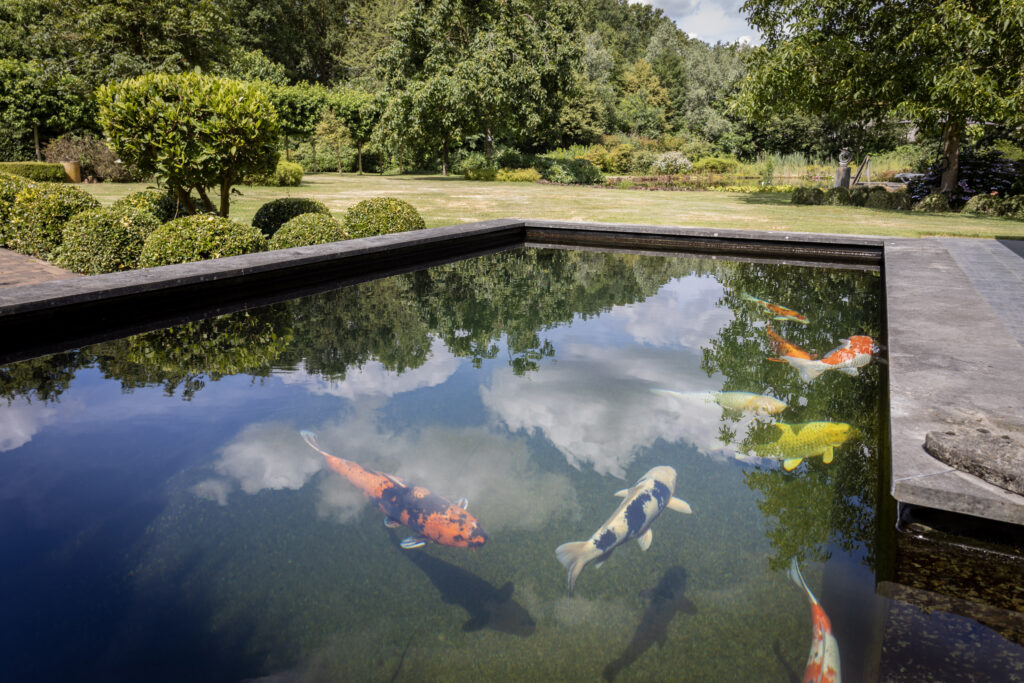
A crystal-clear pond where every fish and plant is visible right down to the bottom. That is the goal of every pond enthusiast and a key hallmark of every professional pond installer. Yet many ponds face a persistent problem: green water.
UV-C has been used for years to tackle this problem. But how exactly does UV-C work? And what role do the pond pump and filter play?
In this blog, we explain how UV-C works, how it helps combat green water, and why the right combination of pump, filter and UV-C is essential for effective pond water treatment.
Suspended algae and string algae: what is the difference?
Before looking at the technology, it is important to understand which problem UV-C actually addresses. In the pond industry, we distinguish between several types of algae:
- Suspended algae (green water): These are microscopic, single-celled organisms that freely float in the water. When they multiply rapidly, the pond can turn into a “green soup”, making it almost impossible to see through the water. UV-C is specifically designed to effectively control these suspended algae.
- String algae: These algae attach themselves to walls, rocks and plants. Because they do not freely pass through the pond pump and along the UV-C lamp, UV-C radiation has no direct effect on them.
How does UV-C work in a pond?
The process starts with the pond pump, which circulates the water through the UV-C unit. Inside the unit is a specially designed UV-C lamp that emits ultraviolet (UV-C) light at a specific wavelength.
UV-C radiation damages the DNA of microorganisms, preventing them from reproducing. In the case of suspended algae, this causes the algal cells to become inactive, allowing the green water to gradually become clear again.
UV-C is also used to inactivate various microorganisms, including bacteria and viruses. Its effectiveness depends on factors such as the UV-C dose, water flow and water quality.
Why is a good pond filter important?
A UV-C unit does not work on its own. Effective water treatment consists of several components, including the pond pump and pond filter, which need to be properly matched. A complete and well-balanced system is therefore essential for effective water treatment.
UV-C inactivates suspended algae, but it does not physically remove them from the water. This is where the filter comes in. The filter captures dead or inactivated algae particles and other debris, allowing them to be removed from the water system.
The right combination of pond pump, filter and UV-C therefore provides effective water treatment. The pump determines the water flow, the UV-C system treats the water, and the filter removes the contaminants.
Which Xclear UV-C system is right for my pond?
Whether you have an ornamental pond, swimming pond or koi pond, Xclear offers UV-C solutions for a wide range of applications and capacities. From compact systems for private ponds to professional solutions for larger installations and high flow rates.
- Xclear Series: Easy-to-use units such as the Jumbo Tech, ideal for enthusiastic pond hobbyists.
- Xclear Xpert Series: Powerful systems for professional installers, designed for high flow rates and intensive treatment in koi ponds and swimming ponds.
- Immersion & Module UV-C: Immersion UV-C units that can be installed directly into filter chambers and drum filters, helping to minimise pressure loss.
Want to know which Xclear UV-C solution is right for your pond? Contact an Xclear specialist near you.
Tips for optimal UV-C disinfection performance
To help ensure that your pond water remains clear throughout the season, there are a few important guidelines to keep in mind:
- Replace the lamp on time: A UV-C lamp may continue to produce visible light over time, even though its UV-C output has already decreased significantly. Depending on the lamp type, the recommended service life may be around 9,000 hours for standard lamps and up to 16,000 hours for amalgam lamps.
- Keep the quartz sleeve clean: Limescale and dirt on the quartz sleeve reduce the amount of UV-C radiation reaching the water. Check the quartz sleeve regularly and clean it when necessary.
- Choose the right capacity and wattage: The required UV-C power depends on the application and operating conditions. As a general guideline, around 2–3 watts per 1,000 litres can be used for a garden pond. For koi ponds with a high fish stocking density, 3–4 watts per 1,000 litres may be required.
Please note: The correct UV-C capacity is not determined by pond volume alone. Water flow, fish stocking density, pond location, water quality and application also play an important role. Always select a UV-C system that is suitable for both the pond volume and the required flow rate.
Are you a professional in the pond industry? Become an Xclear dealer today.